6 Signs It's Time to Replace Your Concrete Driveway
Learn the key warning signs that indicate your concrete driveway needs replacement rather than repair, and when it makes sense to invest in a new one.
Daniel Mercer
When Should You Replace Your Concrete Driveway?
Your concrete driveway takes a beating every single day. Between vehicle traffic, Gold Coast’s intense UV radiation, subtropical rain, and salt-laden coastal air, even the best-laid concrete has a finite lifespan. The question is: how do you know when patching and repairs are no longer enough?
We often see homeowners struggling to decide between a quick fix and a fresh start.
Signs of failure aren’t always obvious until they become expensive liabilities.
Our team has inspected thousands of driveways from Coomera to Coolangatta, and we’ve noticed a clear pattern in how these slabs fail.
Understanding the difference between cosmetic wear and structural failure can save you thousands in wasted repairs.
Here are six clear signs that it’s time to consider a full driveway replacement.
1. Widespread Cracking
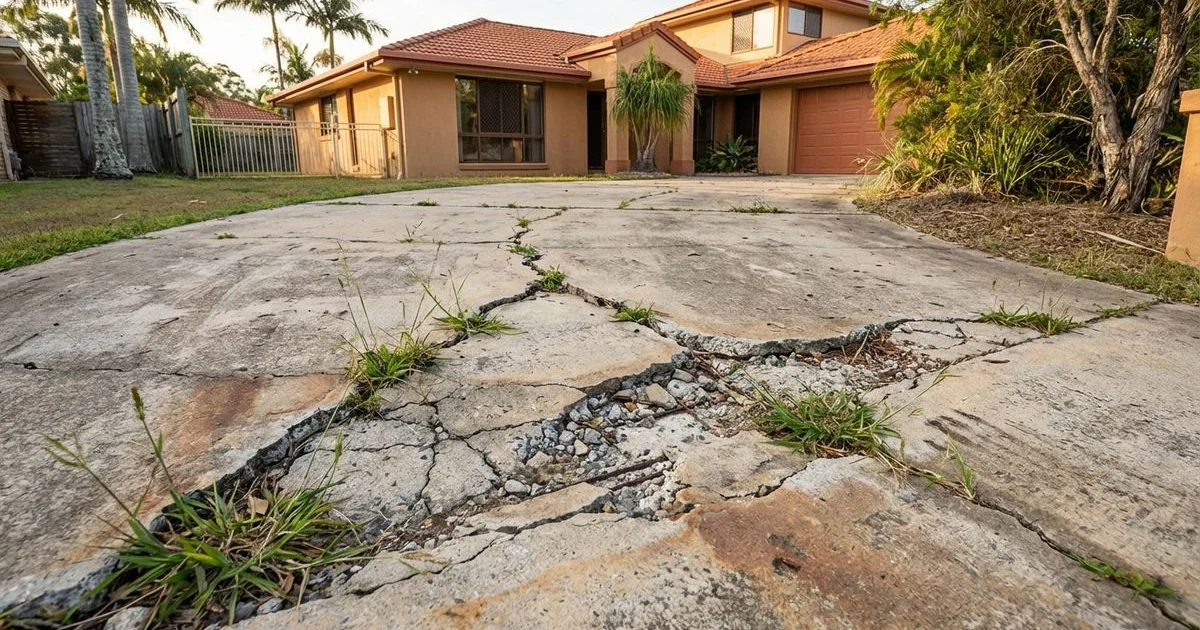
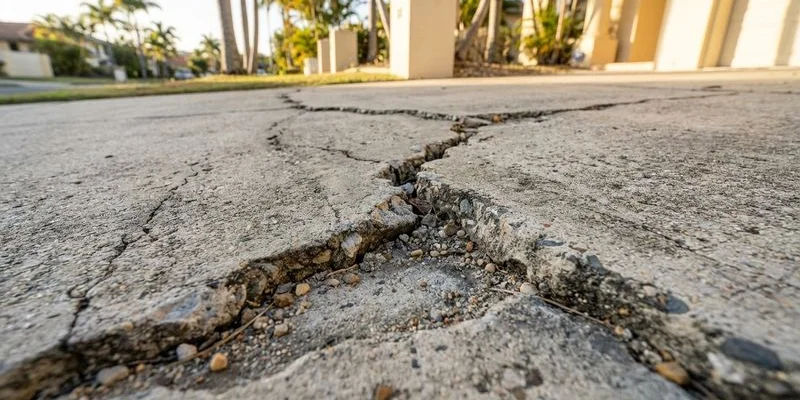
Small hairline cracks are normal and usually cosmetic. However, when you start seeing multiple cracks wider than 5mm, or a network of interconnected cracks spreading across large sections of your driveway, the structural integrity of the slab has been compromised.
We assess these issues against Australian Standard AS 3727, which classifies pavement defects.
Technically, cracks falling into “Category 3” (noticeable) or “Category 4” (distinct) often indicate that the steel reinforcement inside has snapped or corroded.
Our local experience points to a specific culprit: the reactive clay soils found in suburbs like Nerang, Coomera, and Robina.
These “Class H” (highly reactive) or “Class E” (extremely reactive) soils swell when wet and shrink when dry, snapping rigid slabs that weren’t engineered for such movement.
Once cracking becomes widespread, water infiltration accelerates further deterioration from underneath.
2. Sunken or Uneven Sections
If sections of your driveway have sunk or become noticeably uneven, the base material underneath has likely failed. This creates trip hazards, pools standing water, and can damage vehicles scraping over the transitions.
We use a simple metric from the QBCC standards: if a section has subsided more than 15mm under a 3-metre straight edge, it is considered a defect.
Sinking often indicates poor compaction during the original installation, erosion of the sub-base from water penetration, or significant soil movement.
Our crews frequently encounter driveways in Burleigh Waters where localized subsidence has caused slabs to tilt or drop completely.
While “mudjacking” or foam injection can sometimes lift a slab, it is often a temporary band-aid if the sub-base is washed out.
Widespread sinking usually means the base needs to be rebuilt entirely — which means replacing the slab.
3. Extensive Spalling and Surface Deterioration
Spalling is when the top layer of concrete flakes, chips, or peels away, exposing the rough aggregate beneath. On the Gold Coast, spalling is commonly caused by:
- Poor finishing during the original pour (often adding too much water to the mix)
- Inadequate curing in hot weather
- Lack of sealing, allowing moisture and salt to penetrate
- Years of UV exposure breaking down the surface
We recommend checking for “delamination” by tapping the surface with a hammer; a hollow sound means the top layer is separating.
In coastal zones, this is often accelerated by “chloride ingress,” where airborne salt attacks the concrete paste.
Our standard for new coastal driveways is N32 grade concrete (32 MPa strength), whereas older driveways were often poured with weaker N20 or N25 mixes that can’t handle the salt.
Minor spalling can be repaired with concrete resurfacing, but when more than 30 to 40 per cent of the surface is affected, replacement is more cost-effective than repeated patchwork.
4. Drainage Problems
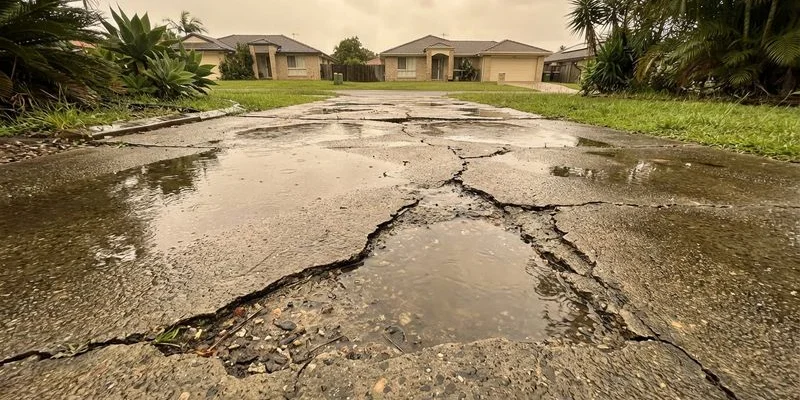
A properly installed driveway should direct water away from your home and garage. If you notice water pooling on the surface, flowing towards your house, or collecting against the garage slab, the driveway’s fall has been compromised.
We follow the Building Code of Australia (BCA) requirement for a minimum gradient of 1:100 (or 10mm of fall for every metre of length) to ensure water runs off effectively.
This is particularly concerning on the Gold Coast where summer storms can dump enormous amounts of rain in short bursts.
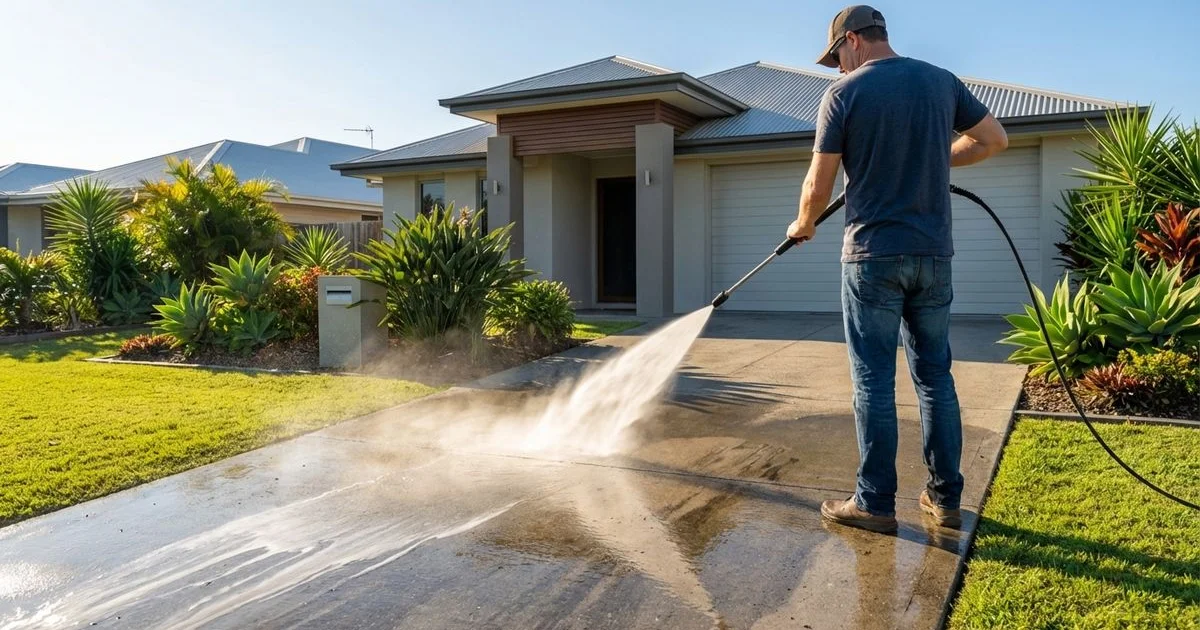
Our “hose test” is a quick way to check this: spray water on the slab and wait 15 minutes; if water is still pooling deeper than 10mm, the drainage has failed.
Poor driveway drainage can contribute to flooding, foundation damage, and mould issues in adjoining structures.
5. The Driveway Is Over 25 Years Old
Most residential concrete driveways are designed to last between 25 and 30 years. If your driveway was poured more than two decades ago, it was likely built to different standards than what we use today.
We find that many driveways from the 1990s utilized lighter F62 mesh, which provides significantly less tensile strength than the modern SL72 or SL82 steel mesh we install now.
Older driveways on the Gold Coast often feature:
- Thinner slabs (75mm instead of the current standard 100mm)
- Lighter reinforcement or no reinforcement at all
- No sealer applied during or after construction
- Inadequate sub-base preparation compared to modern requirements
Even if an older driveway looks acceptable on the surface, hidden issues like corroded reinforcement and sub-base erosion may be lurking beneath.
6. Repair Costs Are Adding Up
There comes a tipping point where ongoing repairs become more expensive than simply starting fresh. If you’ve already spent money on crack filling, patching, and concrete repairs over the past few years, and the problems keep returning, that money is better directed toward a new driveway.
We advise clients to use the “50% Rule”: if the quote to repair your driveway is half the cost of a new one, replacement is the smarter financial move.
Market rates for 2026 in South East Queensland show a distinct gap between extensive repairs and new installs.
Our analysis of current local pricing highlights the value proposition:
| Service Option | Estimated Cost (Per m²)* | Durability Outlook |
|---|---|---|
| Resurfacing / Spray Pave | $50 - $100 | 5-10 Years (Cosmetic only) |
| New Plain Concrete | $80 - $150 | 30+ Years (Structural renewal) |
| New Exposed Aggregate | $150 - $250 | 30+ Years (Premium finish) |
Note: Prices vary based on site access, excavation needs, and size.
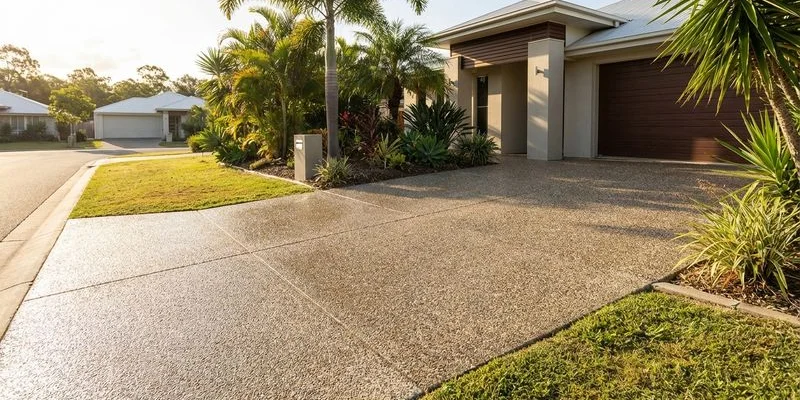
You’ll get a brand-new slab with modern reinforcement, proper drainage, a fresh sealer, and a full lifespan ahead of it.
What to Do Next
If you’ve spotted one or more of these signs on your driveway, the next step is to have a qualified concreter assess the situation in person. Some issues that look severe on the surface may be repairable, while other driveways that appear fine could have hidden structural problems.
We recommend getting a professional opinion before spending money on patches from a hardware store.
A professional assessment should include:
- Checking the concrete slab thickness and reinforcement condition
- Evaluating sub-base integrity
- Measuring drainage falls
- Identifying the root cause of any visible damage
On the Gold Coast, it’s especially important to choose a concreter who understands our local soil conditions, climate challenges, and council requirements. This ensures your new driveway is built to handle everything our subtropical environment throws at it.