The Complete Guide to Shed Slabs on the Gold Coast
Everything you need to know about pouring a shed slab on the Gold Coast, including sizing, thickness, reinforcement, drainage, and council requirements.
Daniel Mercer
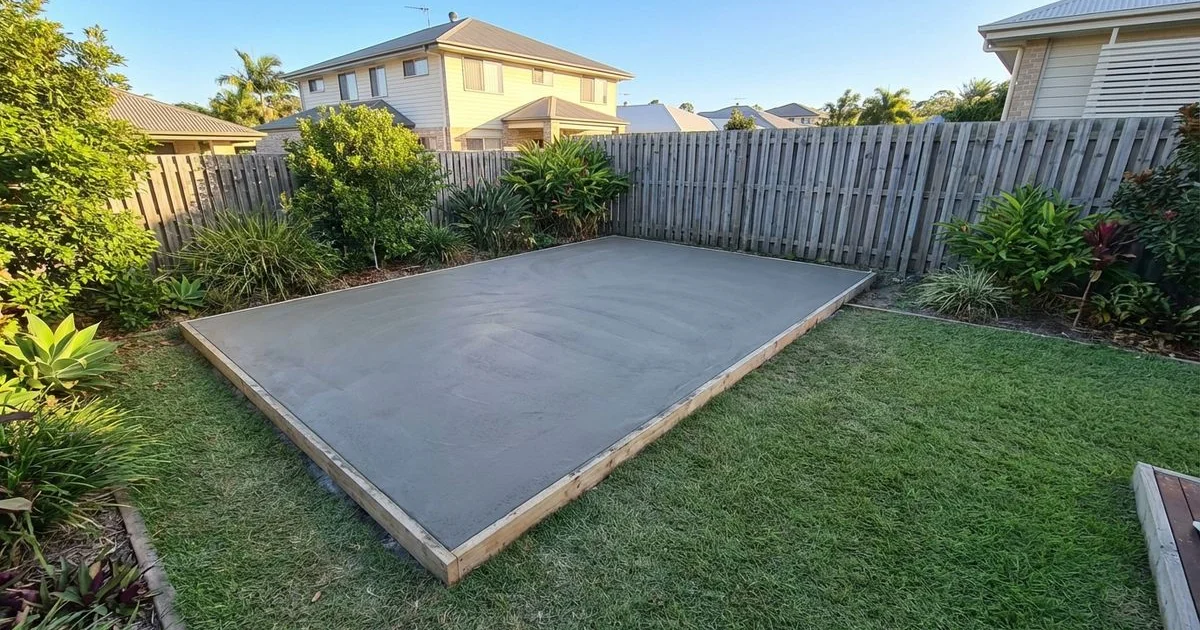
Planning Your Shed Slab on the Gold Coast
Building a shed here isn’t just about extra storage; it’s about protecting your gear from our intense sub-tropical climate. You know how quickly a summer storm rolls in over the hinterland and dumps inches of rain in minutes.
We have seen plenty of standard concrete slabs crack or flood because they weren’t built for local conditions.
The foundation determines if your new structure stays dry during a February downpour or shifts during a dry August.
Our team wants to help you get this right the first time so you don’t face expensive concrete repairs later.
Let’s look at the specific soil challenges in our region, the regulations you need to know, and the costs involved in 2026.
Slab Sizing and Thickness
Standard Shed Sizes
Selecting the right footprint is the first step. Homeowners in our region typically opt for these dimensions based on standard residential block sizes:
- Garden shed: 3m x 3m or 3m x 4.5m (Perfect for mowers and tools)
- Single garage/workshop: 6m x 6m (Fits a standard vehicle plus bench space)
- Double garage: 6m x 9m (Accommodates two cars or a boat)
- Large workshop/barn: 9m x 12m or larger (Ideal for acreage properties in Maudsland or Tallebudgera)
Recommended Thickness and Strength
Most people assume concrete is concrete, but thickness matters immensely.
We recommend a 100mm thick slab as the absolute baseline for garden sheds.
If you plan to park a LandCruiser, a caravan, or heavy machinery inside, that 100mm standard is risky.
Heavier loads require a thickness of 125mm or 150mm to prevent cracking under the point load of tires or jacks.
This extra concrete creates a “heavy duty” rating capable of handling vehicle weights common in Queensland households.
Your slab must also extend 100mm beyond the shed walls on every side.
This extension serves as a vital barrier against vermin and water ingress.
Site Preparation
The Gold Coast has incredibly diverse geology, ranging from pure sand to reactive clay.
We approach site preparation differently depending on your postcode.
Excavation and Levelling
A flat pad is non-negotiable.
Suburbs like Mudgeeraba, Highland Park, and Pacific Pines are notorious for their slopes.
Excavation there often involves significant “cut and fill” to create a level platform.
Flatter suburbs closer to the water require less earthmoving but often need better compaction due to sandy soil.
Compacted Base
A stable slab starts with what sits underneath it.
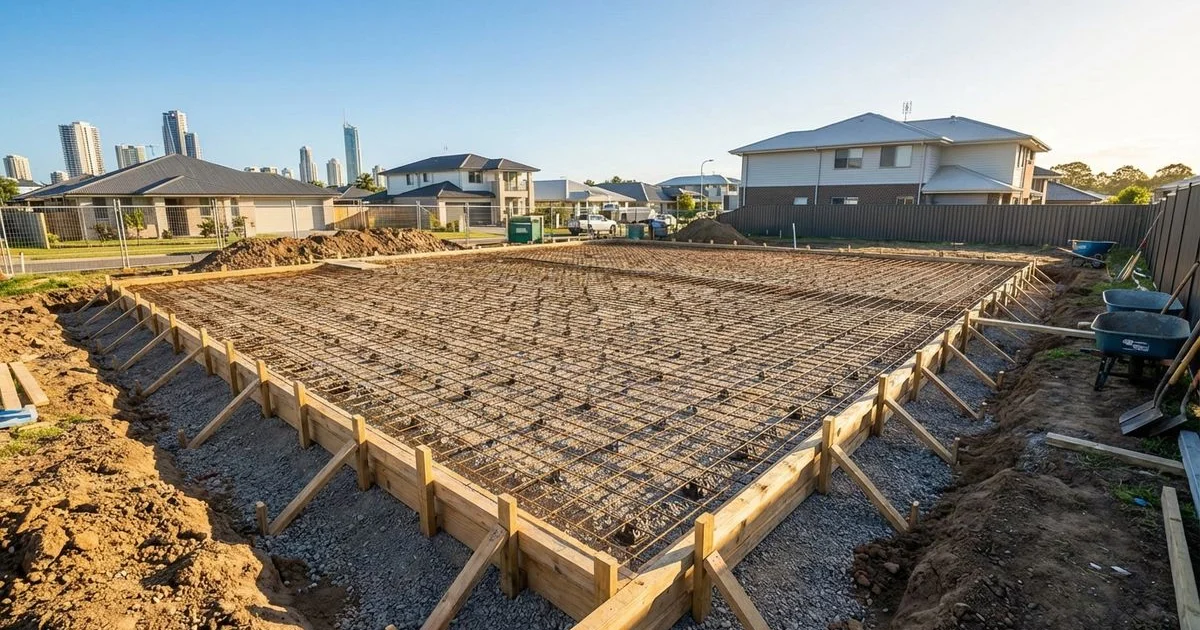
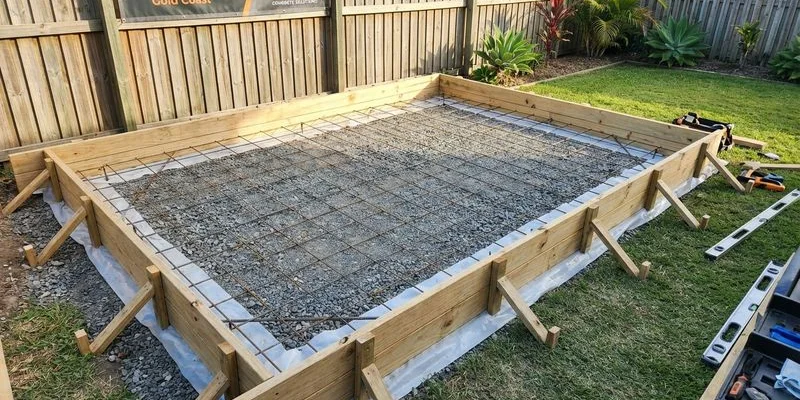
Our crews lay a compacted gravel or “crusher dust” base, typically 50mm to 100mm deep, over the subgrade.
This layer acts as a shock absorber.
Reactive clay soils, found heavily in Coomera and Pimpama, swell when wet and shrink when dry.
The gravel base minimizes the impact of this ground movement on your concrete.
Vapour Barrier
Rising damp is a silent destroyer of shed contents.
We install a 0.2mm (200 micron) polyethylene vapour barrier over the gravel before a single drop of concrete is poured.
This plastic sheet stops ground moisture from wicking up into the slab.
Without it, you might find your stored tools rusting or cardboard boxes turning to mush, especially in low-lying areas like Carrara or near the canals.
Reinforcement
Steel Mesh Options
Steel mesh holds the concrete together when the ground shifts.
We typically see two main grades used in residential projects.
Comparison of Steel Mesh Grades:
| Mesh Grade | Bar Diameter | Best Application | Cost Impact |
|---|---|---|---|
| SL72 | 6.75mm | Garden sheds, pedestrian traffic, light storage. | Standard |
| SL82 | 7.6mm | Workshops, garages, vehicle storage, heavy machinery. | Moderate Increase |
Standard sheds often use SL72, but upgrading to SL82 is a smart insurance policy for a small price difference.
Edge Beams
The perimeter of your slab carries the weight of the shed walls and roof.
We dig a thickened edge, known as an edge beam, typically 300mm deep and 300mm wide.
This internal “footing” adds immense stiffness to the slab.
It creates a rigid ring that helps the entire foundation resist twisting forces during seasonal soil changes.
Drainage Considerations
The Gold Coast averages around 1,200mm of rainfall annually, but it often arrives in short, intense bursts.
You need a plan for where that water goes.
Surface Fall
Water must never pool around your shed.
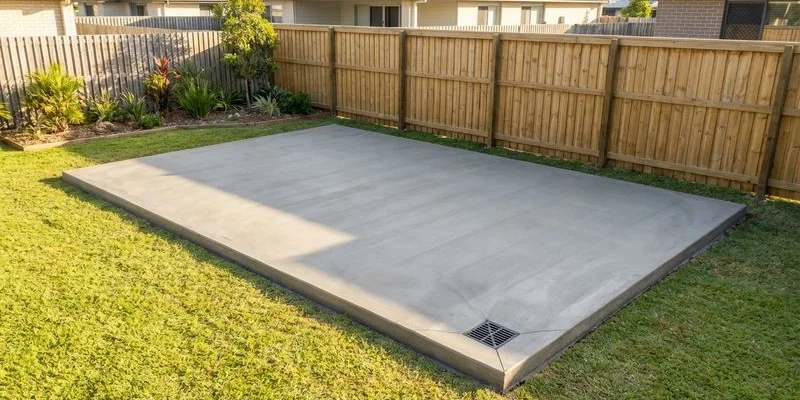
We ensure the slab surface has a fall of roughly 1 to 2 per cent (10-20mm drop over 1 metre) towards the door or a drain.
This subtle slope ensures that if you hose out the shed, or if rain blows in, it flows right back out.
Perimeter Drainage
Water sitting against the edge of a slab softens the soil and causes sinking.
Homeowners should install a gravel drainage strip or an agricultural (ag) pipe system around the base.
This is critical on flat blocks in suburbs like Robina where water tends to sit on the surface after a storm.
Gold Coast Council Requirements
Skipping the paperwork is the fastest way to get a fine or a demolition order.
We advise checking the Gold Coast City Plan and Queensland Development Code (QDC) MP 1.2 before starting.
When You Need Approval
Council rules are specific about size and location.
- Size: Sheds larger than 10 square metres usually trigger the need for a building approval.
- Height: If the overall height exceeds 2.4m, setback rules become stricter.
- Length: If the structure is longer than 9m along a boundary, you will likely need a relaxation application.
Building Codes
Compliance ensures safety and insurability.
All work must adhere to AS 2870 (Residential Slabs and Footings).
Your certifier will require a Form 15 (Compliance Certificate for Building Design) and a Form 16 (Inspection Certificate) from the concreter or engineer.
Flood Overlays
Many parts of the coast are mapped as flood zones.
We often have to pour slabs at a specific “minimum habitable floor level” in areas like Hope Island or Helensvale.
This might mean raising the slab height significantly, which requires extra fill and stronger engineering.
Cost Expectations (2026 Estimates)
Concrete prices have shifted, so it pays to have realistic budget expectations.
The following ranges cover materials and labour for a standard site with easy access.
Estimated Slab Costs:
| Shed Type | Size | Approx. Cost Range |
|---|---|---|
| Small Garden Shed | 9m² | $1,800 - $2,500 |
| Single Garage | 36m² | $4,200 - $6,000 |
| Double Garage | 54m² | $6,500 - $9,000 |
| Large Workshop | 108m² | $12,000 - $18,000 |
These figures include the base, vapour barrier, SL72 mesh, and a standard finish.
Factors That Increase Price:
- Concrete Pumping: If a concrete truck cannot back up to the site (common in battle-axe blocks), a line pump costs an extra $800-$1,200.
- Excavation: Sloping sites requiring machinery hire add to the bill.
- Rebated Edges: Creating a step-down for water protection takes more time and skill.
Tips for a Successful Shed Slab
A few insider adjustments can make a huge difference to the final result.
1. Request a Rebated Edge
We highly recommend asking for a “rebate” or step-down at the perimeter.
This design feature prevents wind-driven rain from creeping under the bottom track of your shed walls.
2. Install Anchor Bolts Wet
Drilling into hardened concrete risks cracking the edge.
Have your concreter set the “J-bolts” or anchors into the wet concrete exactly where the shed frame requires them.
3. Don’t Ignore Curing
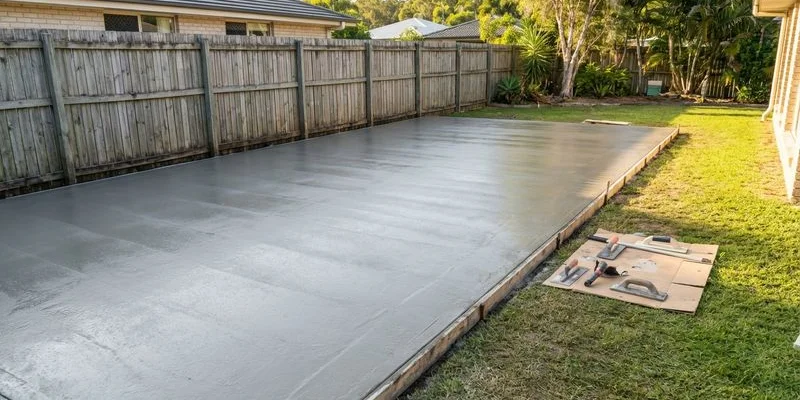
Concrete needs time to reach full strength.
Keep the slab damp for at least 3-5 days after pouring, especially during our hot September to March period, to prevent hairline cracks.
4. Plan for Plumbing
Concrete grinding and cutting later is expensive and messy.
If you think you might want a sink or a toilet in the workshop one day, lay the pipework before the pour.
5. Check the Mesh Height
Reinforcing mesh only works if it sits in the top third of the slab.
Ensure your concreter uses “bar chairs” to keep the steel elevated rather than just pulling it up with a rake during the pour.
A well-planned slab is the silent partner in your shed’s longevity.
It provides the stability your structure needs to withstand the Gold Coast climate for decades.