How Much Does a Concrete Pool Surround Cost on the Gold Coast?
Detailed pricing guide for concrete pool surrounds on the Gold Coast, covering exposed aggregate, honed, stamped, and standard finishes with real cost examples.
Daniel Mercer
Pool Surround Costs on the Gold Coast
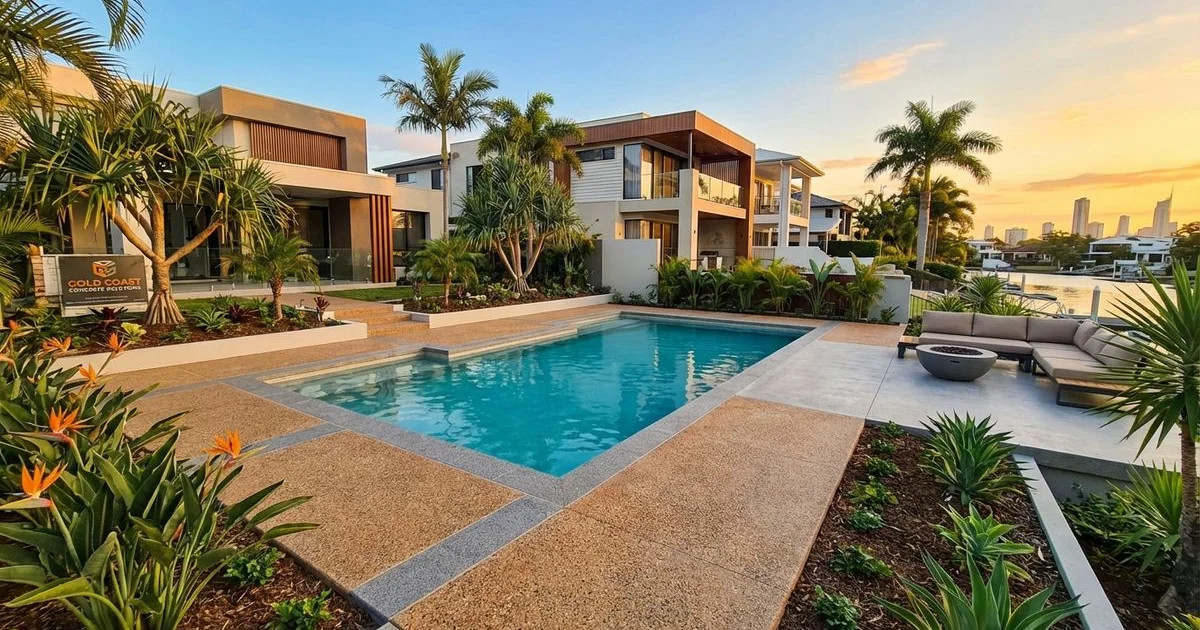
A quality concrete pool surround transforms your backyard into a genuine outdoor living space. On the Gold Coast, where we use our pools year-round, this investment delivers daily value.
But before you commit, understanding the real costs involved helps you plan your budget. Comparing quotes effectively requires knowing exactly what you are paying for.
This guide covers everything that goes into pool surround pricing on the Gold Coast.
Per-Square-Metre Rates by Finish
Here is what Gold Coast concreters are quoting for pool surround work in 2026.
We have adjusted these figures to reflect current material costs and labour rates in Southeast Queensland.
| Finish | Price per m² | Best Use Case |
|---|---|---|
| Coloured Concrete (Broom) | $85-$120 | Budget-friendly, high grip |
| Honed Concrete | $130-$180 | Premium smooth look, indoor-outdoor flow |
| Stamped Concrete | $100-$150 | Replicating stone or timber patterns |
| Exposed Aggregate | $110-$160 | Durable, high grip, hides dirt well |
| Spray-on Resurfacing | $50-$85 | Renovating existing stable slabs |
These rates generally include standard site preparation, formwork, SL72 or SL82 reinforcement, concrete supply, finishing, and initial sealing.
Pool surround work sits at the higher end of these ranges compared to driveways. The complexity is higher due to curved formwork around the pool shell, precise drainage falls, and the critical need for non-slip finishing.
Total Cost by Pool Size
To give you a realistic sense of total project cost, we have broken down common scenarios found across the Gold Coast.
These estimates assume a flat block with standard access.
Small Pool (Plunge Pool or Spa)
- Surround area: 15-25m²
- Exposed aggregate: $1,800-$4,000
- Coloured concrete: $1,275-$3,000
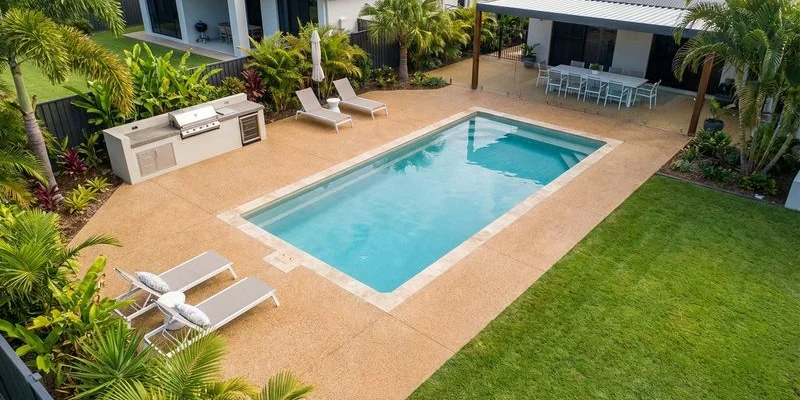
Standard Residential Pool (7m x 4m)
- Surround area: 35-50m²
- Exposed aggregate: $4,000-$8,000
- Coloured concrete: $3,000-$6,000
Large Pool with Entertaining Area
- Surround area: 60-100m²
- Exposed aggregate: $7,000-$16,000
- Coloured concrete: $5,100-$12,000
Resort-Style Pool with Full Outdoor Living
- Surround area: 100-150m²
- Exposed aggregate: $12,000-$24,000
- Coloured concrete: $8,500-$18,000
What’s Included in the Price
A comprehensive pool surround quote should be transparent.
We ensure our quotes itemise these specific inclusions to avoid surprises later.
Site Preparation and QBCC Compliance
- Excavation: Removal of earth to the required depth (usually 100mm to 150mm).
- Sub-base: Installation of a compacted road base or gravel layer.
- Compliance: Verify that the project value includes QBCC insurance if the total work exceeds $3,300.
Formwork and Reinforcement
- Framing: Timber or flexible steel formwork secured against the pool beam.
- Steel Mesh: SL72 or SL82 steel reinforcing mesh placed on bar chairs to sit in the top third of the slab.
- Bond Breakers: Foam isolation joints where the concrete meets the pool coping or house slab to prevent cracking.
Concrete and Finishing
- Supply: 25 MPa or 32 MPa concrete mix designed for coastal exposure.
- Placement: Pumping or wheelbarrowing the mix into place.
- Finishing: Screeding, bull-floating, and applying the chosen texture.
- Falls: Creating a 1-2% slope away from the pool to prevent dirty water from washing back into the filter.
Sealing and Clean-Up
- Sealing: Application of a high-quality penetrating or topical sealer.
- Safety: Addition of a non-slip additive (often called “grit”) to meet Australian Standards for wet areas.
- Clean-up: Removal of all formwork timber and construction debris.
Additional Costs to Factor In
Pool Coping
Pool coping is the finished edge around the top of the pool shell. It sits between the water and the concrete surround.
Coping is almost always quoted separately from the main slab.
- Poured concrete coping: $50-$90 per lineal metre
- Pre-cast concrete coping: $70-$130 per lineal metre
- Natural stone (Travertine/Limestone): $110-$220 per lineal metre
- Drop-edge (Rebate) coping: $90-$160 per lineal metre
For a standard 7m x 4m pool (22 lineal metres), expect to add $1,100-$3,500. This depends entirely on whether you choose a standard paver or a premium natural stone.
Demolition of Existing Surround
Replacing an old surround requires heavy labour.
Demolition and disposal fees typically add $25-$45 per square metre. We have to account for tip fees at local Gold Coast waste management centres, which charge by weight.
Drainage and Plumbing
Proper drainage is essential in Queensland’s tropical climate.
Water must go somewhere during a summer storm.
- Strip drains (Aluminium/Stainless): $90-$180 per lineal metre
- Stormwater connection: $400-$900
- Hidden slot drains: $150-$250 per lineal metre
Retaining Walls and Level Changes
Gold Coast properties with sloping blocks often need retaining walls to flatten the pool area.
This is a significant cost. You might pay anywhere from $250 to $650 per square metre of retaining wall face. The price varies based on whether you use concrete sleepers, link blocks, or rendered masonry.
Steps and Feature Walls
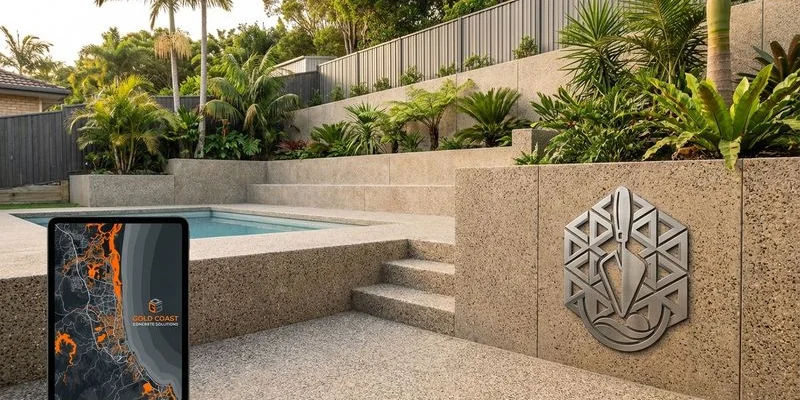
Concrete steps connecting the house to the pool area are custom work.
We quote these separately based on the number of risers and the complexity of the formwork.
Factors That Influence Your Quote
Pool Shape
Freeform and kidney-shaped pools are iconic, but they are harder to pour around.
Curved formwork requires flexible boards and more pegs. A curved design might cost 15 to 25 per cent more in labour compared to a straight-edged geometric pool.
Site Access
Concrete trucks are heavy and wide.
If your property has narrow side access (less than 3 metres wide), a concrete truck cannot pour directly. We will need to hire concrete pumping services.
- Line Pump: $600-$1,000 (runs a hose through your property).
- Boom Pump: $1,200-$1,800 (cranes the pipe over your house).
Ground Conditions
The Gold Coast has diverse soil types ranging from sandy coastal strips to reactive clay in the hinterland.
Reactive clay requires thicker steel reinforcement and potentially deeper edge beams to prevent the slab from heaving. Sandy soil is generally easier to work with but may require stabilising if it is too loose.
Surround Width
A narrow 1-metre path costs less in materials.
However, we strongly recommend a minimum width of 1.5 metres. This allows two people to walk past each other safely. For sun lounges, you typically need 2.5 to 3 metres of width.
Integration with Other Features
Bundling projects is smart.
If the pool surround connects to a patio, BBQ area, or fire pit, doing it all at once saves money. You only pay for the pump hire and establishment fees once.
Saving Money on Your Pool Surround
Plan Early
The best time to engage a concreter is before the pool shell is finished.
We can work alongside the pool builders to prepare the sub-base using their machinery. This avoids double-handling the earthworks.
Choose Standard Aggregate
Custom mixes with rare stones are pricey.
Standard aggregate blends from local suppliers like Hanson, Boral, or Holcim look fantastic. Choosing a “stock” mix can save you 10 to 15 per cent on the material bill without sacrificing quality.
Bundle with Other Work
Think about your concrete driveway or side paths.
Combining these areas into a single pour reduces the cost per square metre. Volume discounts often apply when ordering larger loads of concrete.
Correct Sizing
Bigger isn’t always better.
A well-proportioned surround balances function and cost. We suggest keeping the “transit” areas (walking paths) at 1.2 to 1.5 metres, and only widening the slab in specific “zones” meant for furniture.
What to Ask Your Concreter
When getting quotes for your Gold Coast pool surround, ask specific questions to protect yourself.
We recommend getting these answers in writing:
- Is QBCC insurance included? (Required for jobs over $3,300).
- Does the rate include the concrete pump hire?
- What specific “MPA” (strength) concrete will be used? (Should be 25 MPa or higher).
- How are you managing expansion joints? (Crucial for preventing cracks).
- Is the sealer solvent-based or water-based?
- What drainage provisions are included?
- Is coping included or quoted separately?
Getting clear answers ensures you are comparing accurate figures. It avoids the stress of variation fees once the wet concrete hits the ground.