Polished Concrete vs Tiles: The Best Flooring for Gold Coast Homes
An honest comparison of polished concrete and tiles for Gold Coast homes. Compare cost, durability, maintenance, comfort, and suitability for our climate.
Daniel Mercer
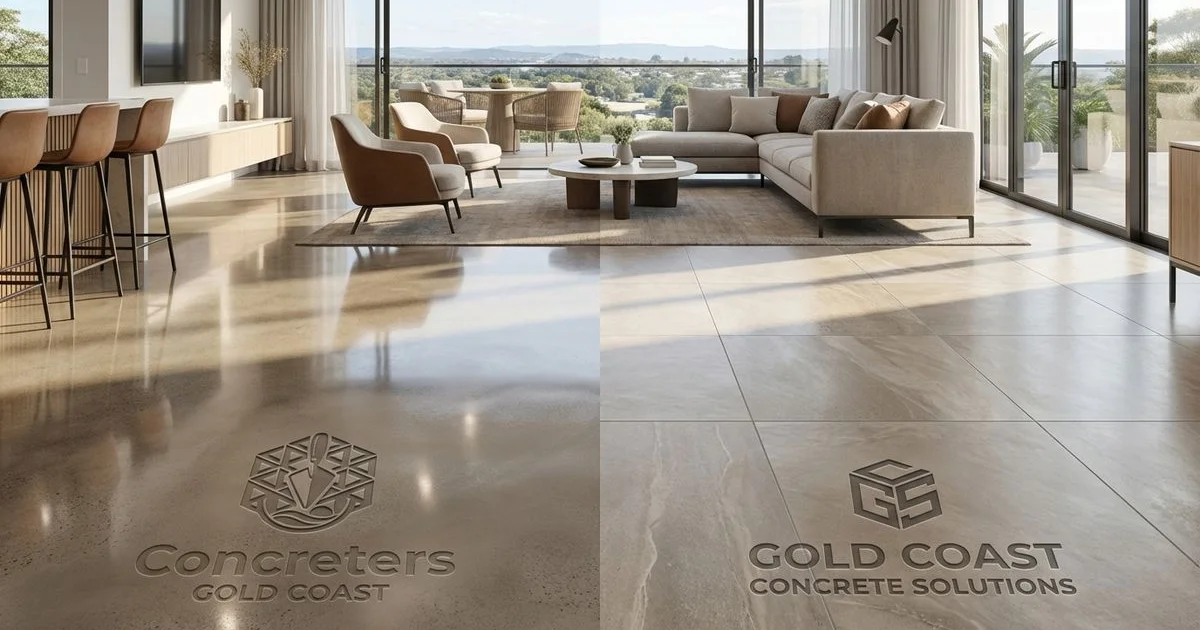
Polished Concrete vs Tiles: Which Flooring Wins?
Deciding between polished concrete and tiles is easily the most debated topic we encounter with Gold Coast homeowners. You likely know the struggle of finding a floor that handles sandy feet, high humidity, and the occasional dropped surfboard.
We see both materials, especially polished concrete floors, performing well in our subtropical climate.
The real difference lies in how they handle the specific stresses of coastal living over ten or twenty years.
Our team wants to help you move past the aesthetic debate and look at the numbers.
This guide breaks down the true cost of ownership, the reality of maintenance, and which option actually survives best in a reactive soil environment.
Cost Comparison
We find that most people underestimate the cost of high-end tiling and overestimate the cost of mechanical polishing.
It helps to look at the “finished floor” price rather than just the material cost.
Upfront Costs
Polished concrete: We typically see pricing structures fall into these ranges for 2025/2026:
- Grind and Seal: $60-$90/m². This is a surface coating rather than a mechanical polish.
- Mechanically Polished Concrete (MPC): $110-$180/m². This involves hardening the slab itself.
- Preparation: $10-$25/m². Removing old glue or carpet is often necessary.
Quality tiles: The sticker price on the box is misleading because it ignores the massive labour component.
- Ceramic/Porcelain Tiles: $40-$100/m² (supply only).
- Natural Stone: $130-$300/m² (supply only).
- Installation Labour: $60-$120/m². Large format tiles often cost more to lay.
- Adhesives and Grout: $15-$25/m².
- Bedding/Levelling: $25-$50/m². Most slabs are not flat enough for large tiles without this step.
A quality porcelain tile installation often ends up costing $140-$250 per square metre once fully laid.
We have noticed that mechanically polished concrete is generally price-competitive with mid-to-high-range tiling projects.
Lifetime Costs
This is where the math changes significantly in favour of concrete.
Polished concrete: Our clients spend very little on upkeep after the install.
- Refining: A re-buff or “grout” (not actual grout, but a pore filler) touch-up might be needed every 7-10 years ($20/m²).
- Cleaning: pH-neutral cleaner is the only ongoing expense.
Tiles: Grout is the financial drain here.
- Professional Cleaning: $5-$8/m² every 1-2 years.
- Grout sealing: Essential for light colours ($10/m²).
- Cracked Tile Replacement: $150+ call-out fees plus materials.
Durability
Polished Concrete
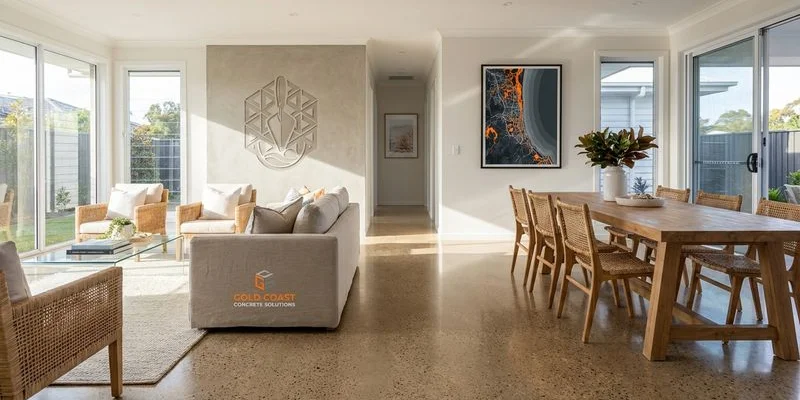
We consider mechanically polished concrete to be the gold standard for hardness.
The process uses a chemical hardener (densifier) that reacts with the lime in the cement to increase the surface hardness from about 3-4 to 7-8 on the Mohs scale.
It resists the scratching from sand tracked in from Burleigh or heavy furniture being dragged across it.
The Insider Risk: Concrete is rigid. If your house slab cracks due to significant ground movement, the polished surface will show that crack. However, we can usually apply concrete repairs with colour-matched grout to make them a “character feature” rather than a defect.
Tiles
Quality porcelain is incredibly hard and rates similarly to concrete on the Mohs scale.
The weakness is not the tile itself but the installation system.
- Impact Damage: Dropping a heavy cast-iron pan will shatter a tile, requiring difficult replacement.
- Grout Failure: Grout is softer than the tile and will erode or stain over time.
- Drumming: On the Gold Coast, we have reactive clay soils. As the slab moves, tiles can delaminate (pop loose) and sound hollow or “drummy” when walked on.
Maintenance
Polished Concrete
We tell our clients that “low maintenance” does not mean “no maintenance.”
Sand is the enemy of any floor finish. You simply need to run a dust mop or a microfiber sweeper over it daily to keep grit off the surface. A wet mop with a pH-neutral cleaner (like those from reputable construction supply brands) once a week is sufficient.
The Humidity Advantage: Gold Coast summers are wet. Polished concrete has no grout lines, meaning there is nowhere for mould to take hold during those 90% humidity weeks in February.
Tiles
Tiles are hygienic on the surface, but the joints are a different story.
Grout is porous by nature unless you use expensive epoxy grout. It absorbs dirty mop water, spilled wine, and oils.
Common Maintenance Tasks:
- Scrubbing grout lines with a stiff brush.
- Applying penetrating sealers to grout annually.
- Re-grouting bathrooms every 10-15 years.
Thermal Comfort
We know that temperature control is vital in Queensland.
Both materials are part of the “thermal mass” equation, but they behave slightly differently.
Polished Concrete
This material acts as a massive thermal battery.
We explain it like this: in winter, if sunlight hits the slab, the concrete absorbs that heat and radiates it back out for hours after the sun goes down. Conversely, in summer, a shaded concrete slab stays cool, drawing heat out of the room.
A note on hardness: Concrete is hard underfoot. If you spend eight hours a day standing in the kitchen, we recommend a gel mat to reduce fatigue.
Tiles
Ceramic and porcelain also offer thermal mass benefits.
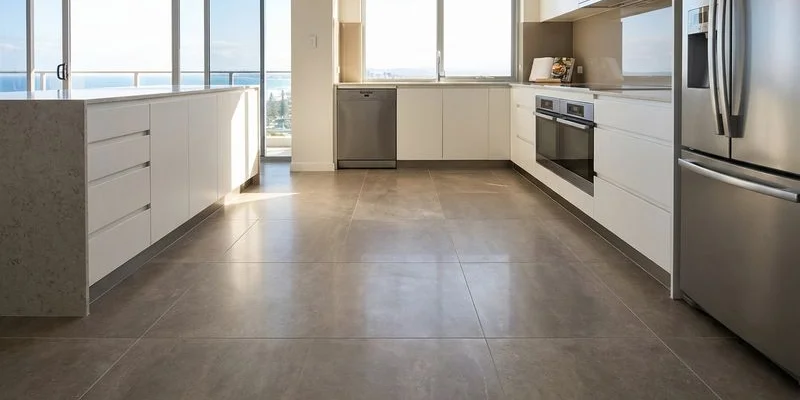
The difference is often in the texture. Tiles can feel colder to the touch instantly because they conduct heat away from your feet faster than some sealed concretes. Underfloor heating systems work exceptionally well with tiles if you are in the cooler hinterland areas like Mount Tamborine.
Design Flexibility
Polished Concrete
We find that homeowners often misunderstand the customisation options here.
You are not stuck with “grey.”
- Aggregate Exposure: You can choose “Nil Exposure” (mostly cement paste, industrial look) or “Full Exposure” (lots of stone visible, looks like terrazzo).
- Matte vs. Gloss: High gloss reflects light and opens up small spaces, while matte hides dust better.
- Seamlessness: The lack of joint lines makes a 100m² living area look significantly larger.
Tiles
This is the choice for specific replication.
If you want the look of timber without the maintenance of wood, timber-look tiles are excellent. You can achieve:
- Marble or Travertine replication without the porosity issues.
- Intricate herringbone or chevron patterns.
- Micro-cement looks (large format tiles).
Suitability for Gold Coast Conditions
Indoor Areas
We recommend polished concrete for main living areas, hallways, and kitchens where traffic is highest.
It creates a seamless flow from the front door to the back deck. Tiles are excellent for breaking up zones, such as defining a sunken lounge or a formal dining space.
Outdoor Areas
Polished Concrete Warning: You cannot use standard high-gloss polished concrete outdoors. It becomes dangerously slippery when wet. We use “Honed Concrete” or “Grind and Seal” with a non-slip additive to achieve a P4 or P5 slip rating, which meets Australian Standards (AS 4586) for pool surrounds and patios.
Tile Warning: External tiles must be rated for outdoor use. Standard internal tiles will be lethal around a pool. You must ensure your tiler uses flexible adhesives to handle the thermal expansion of the Gold Coast sun.
Wet Areas
We generally steer clients toward tiles for bathrooms.
While concrete can be used, achieving the correct falls to drains and perfect waterproofing on a suspended slab is complex and expensive. Tiles remain the king of wet areas due to the ease of waterproofing and the grip texture available for shower floors.
The Verdict
We believe the decision comes down to your lifestyle and the age of your home.
The Comparison Table:
| Feature | Polished Concrete | Quality Tiles |
|---|---|---|
| Initial Cost | Moderate to High ($110-$180/m²) | Moderate to High ($140-$250/m²) |
| Maintenance | Very Low (Dust & Mop) | Medium (Grout Scrubbing) |
| Durability | Extreme (7-8 Mohs) | High (But prone to cracking) |
| Allergy Friendly | Excellent (No dust traps) | Good (Grout can trap dust) |
| Renovation Friendly | Difficult (Needs existing slab) | Excellent (Goes over anything) |
Choose polished concrete if:
- You hate cleaning grout.
- You want that seamless, gallery-style aesthetic.
- You have pets and want a scratch-resistant surface.
- You are building new or have a suitable existing slab.
Choose tiles if:
- You are renovating and the sub-floor is timber or damaged concrete.
- You want a specific pattern or wood-look finish.
- You need to hide an uneven floor surface.
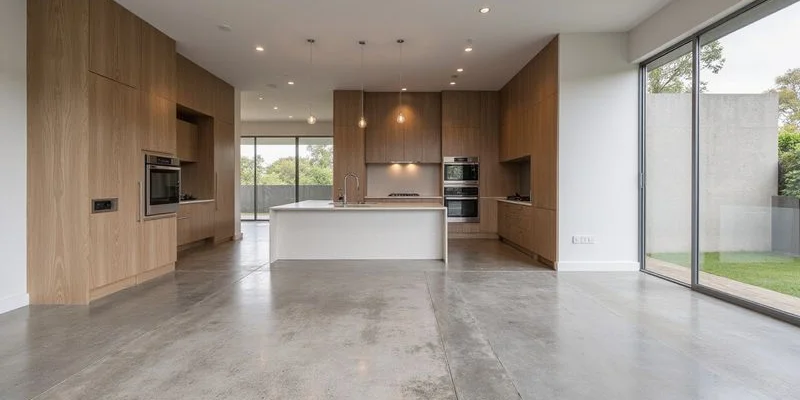
Our team often executes projects that use both. Polished concrete in the main living, dining, and kitchen areas creates a massive sense of space. Then, switching to large-format tiles in the bathrooms and laundry provides the necessary waterproofing and texture.
This hybrid approach really does offer the best of both worlds for a coastal home.