How to Maintain Your Concrete Driveway in Gold Coast's Coastal Climate
Practical tips to maintain your concrete driveway on the Gold Coast. Learn how to protect against UV, salt air, heavy rain, and tropical conditions.
GC Concreting Team
Protecting Your Driveway from the Gold Coast Climate
You know how the sun here seems to age everything faster than anywhere else?
Your concrete driveway faces that same battle every day.
Between the UV index often hitting extreme levels of 11+, the salt spray drifting in from the coast, and our intense storm seasons, concrete takes a beating.
Most homeowners overlook the fact that these elements do more than just make the surface dirty.
They actively break down the binder in your concrete.
We have seen driveways in Broadbeach and Burleigh deteriorate years before they should simply because the maintenance didn’t match the environment.
The good news is that a consistent routine stops this damage in its tracks.
A little effort now keeps your driveway performing for 25 years or more.
Here is our practical guide to keeping your concrete in top condition.
Regular Cleaning
Weekly Sweep
You need to keep the surface free of organic matter.
We recommend a quick sweep once a week to prevent staining.
Gold Coast suburbs are full of shedding trees like Poincianas and Jacarandas, which drop tannin-heavy debris.
If these leaves sit on your concrete during a humid week, they leach dark stains into the pores almost immediately.
A stiff broom or a leaf blower makes this a five-minute job.
Monthly Wash
Give your driveway a wash down every four weeks to remove salt and dust buildup.
This schedule prevents the gritty “sandpaper effect” that wears down your sealer.
Use a standard garden hose and a stiff broom for this task.
For stubborn spots, mix a pH-neutral cleaner with water.
Warning: Avoid harsh ammonia-based cleaners or raw acids.
These chemicals will strip your sealer and can leave the concrete looking patchy or discoloured.
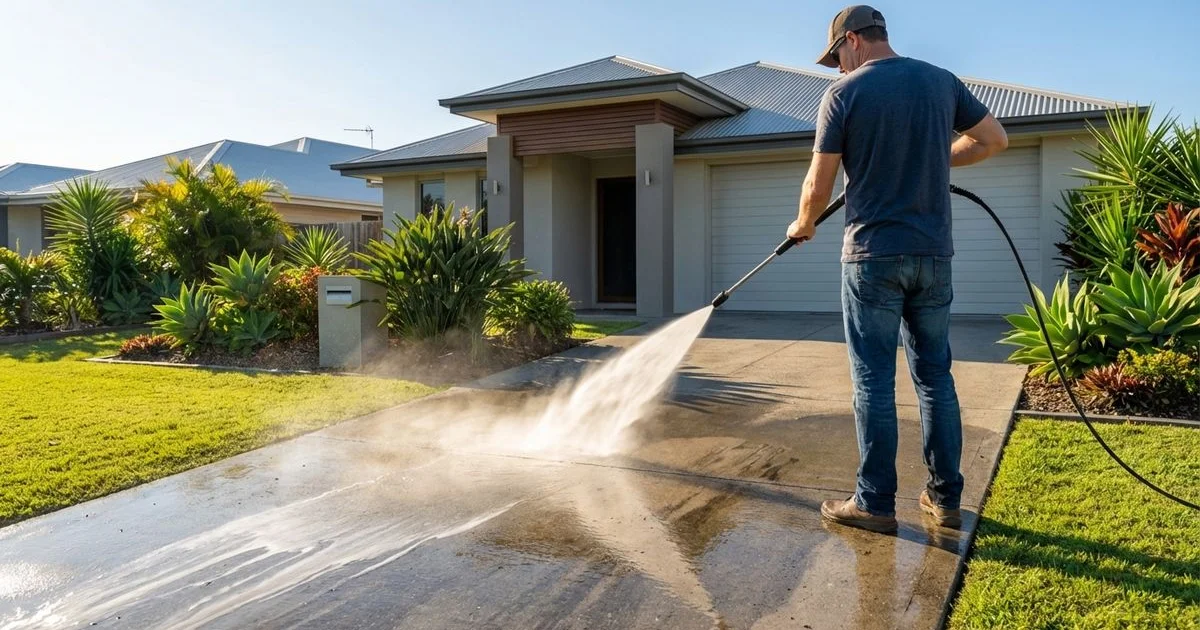
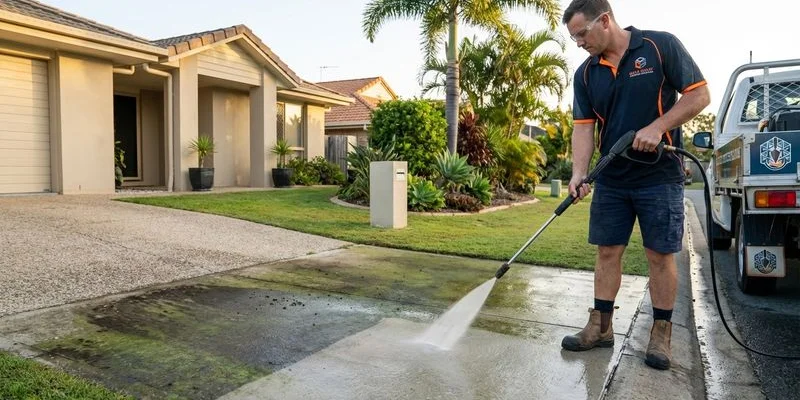
Annual Pressure Wash
Once a year, the driveway needs a deep clean to remove grime, algae, and that familiar black mould.
This growth is particularly aggressive on the Gold Coast in shaded areas or south-facing driveways.
We suggest scheduling this just after the wet season to clear away winter moss.
Pro Tip: Be careful with the pressure settings.
Residential concrete is generally rated for 2500 to 3000 PSI.
Keep the nozzle moving constantly.
Holding a concentrated jet in one spot for too long can etch the surface, exposing the aggregate permanently.
Sealing Your Concrete
Sealing is the single most important maintenance task for Gold Coast driveways.
It is the invisible shield that separates your investment from the elements.
A quality sealer provides a protective barrier against:
- UV damage: It acts like sunscreen, preventing the concrete from fading or chalking.
- Moisture penetration: It stops water from soaking into the slab, which prevents “concrete cancer” (spalling).
- Salt air corrosion: This is non-negotiable for homes east of the highway.
- Oil and chemical stains: It keeps spills on the surface so you can wipe them up.
How Often to Reseal
We generally recommend resealing every 2 to 3 years for optimal protection in this climate.
Many product labels say 5 years, but the Queensland sun degrades topical coatings faster than that.
Driveways in coastal suburbs like Main Beach, Mermaid Beach, and Palm Beach face higher salt exposure.
If your driveway no longer repels water—meaning the water soaks in rather than beading up—it is time to reseal.
Choosing the Right Sealer
The type of sealer you choose determines how the driveway looks and how long it lasts.
Comparison of Sealer Types for Gold Coast Conditions
| Feature | Penetrating Sealer | Topical Acrylic Sealer |
|---|---|---|
| Appearance | Natural, matte finish (invisible) | Glossy or satin “wet look” |
| Best For | Steep driveways, plain concrete | Exposed aggregate, stamped concrete |
| Slip Resistance | Excellent (keeps original texture) | Can be slippery (needs anti-slip additive) |
| Breathability | High (lets moisture escape) | Low (traps moisture if applied wrong) |
| Lifespan | 5-7 years | 2-3 years |
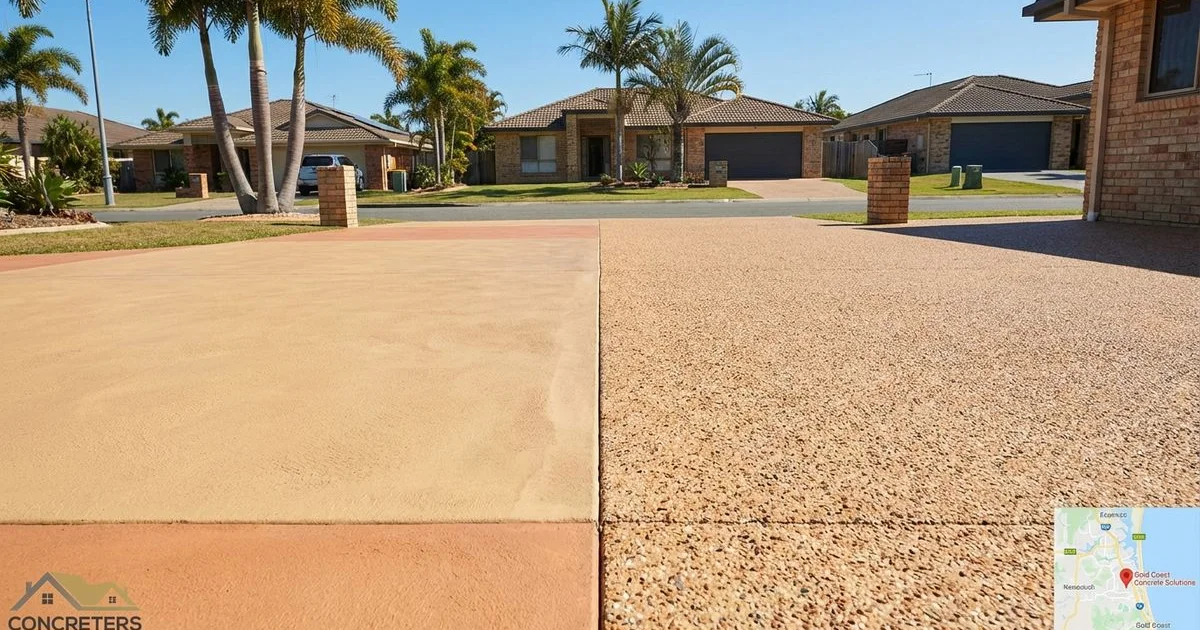
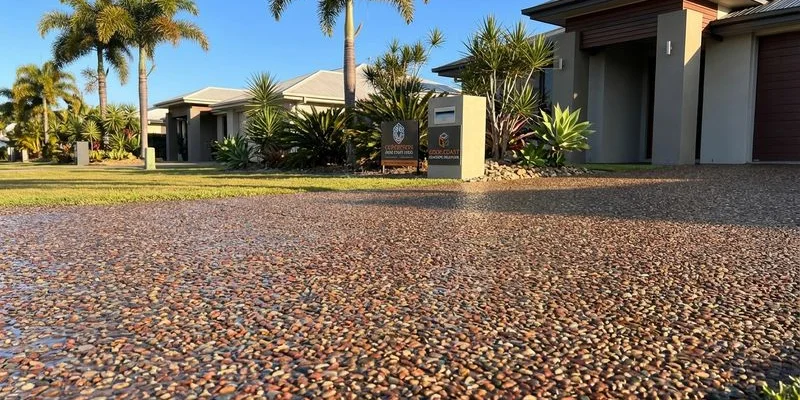
For exposed aggregate, which is very popular here, an acrylic sealer enhances the stone colours beautifully.
Just remember that acrylics sit on top of the surface, so they wear down faster from tyre friction.
Dealing with Stains Promptly
Speed is your best friend when something spills.
Concrete is porous like a sponge, and once a liquid penetrates deep into the capillaries, it is incredibly difficult to remove.
Here are the most common stains we see and how to handle them.
Oil and Grease
Blot up fresh spills immediately with cheap absorbents like kitty litter, sawdust, or even dry sand.
Do not scrub a fresh spill, as this pushes the oil deeper.
For older stains, apply a commercial microbial degreaser.
These products use bacteria to eat the oil rather than just spreading it around.
Rust
Rust stains often come from metal furniture, skip bins, or even lawn fertiliser containing iron.
Many Gold Coast homes on canals also use spear pumps (bore water), which can leave orange iron deposits over time.
Use a dedicated concrete rust remover based on oxalic acid.
Caution: Never use bleach on rust.
Bleach reacts with the iron and will permanently set the stain, making it impossible to remove without concrete grinding the surface.
Tyre Marks
Hot tyres leave rubber residue, especially during January and February when driveway surface temperatures can exceed 60°C.
We find that a citrus-based solvent works best for this.
Apply the solvent, let it dwell for 10 minutes, and scrub firmly with a nylon brush.
Leaf Tannin
Fallen leaves from native trees leave stubborn brown outlines.
These are organic stains, so they react well to oxidation.
A solution of domestic bleach mixed 1:1 with water usually clears this up.
Rinse the area thoroughly after the stain disappears to protect nearby grass or plants.
Crack Monitoring and Repair
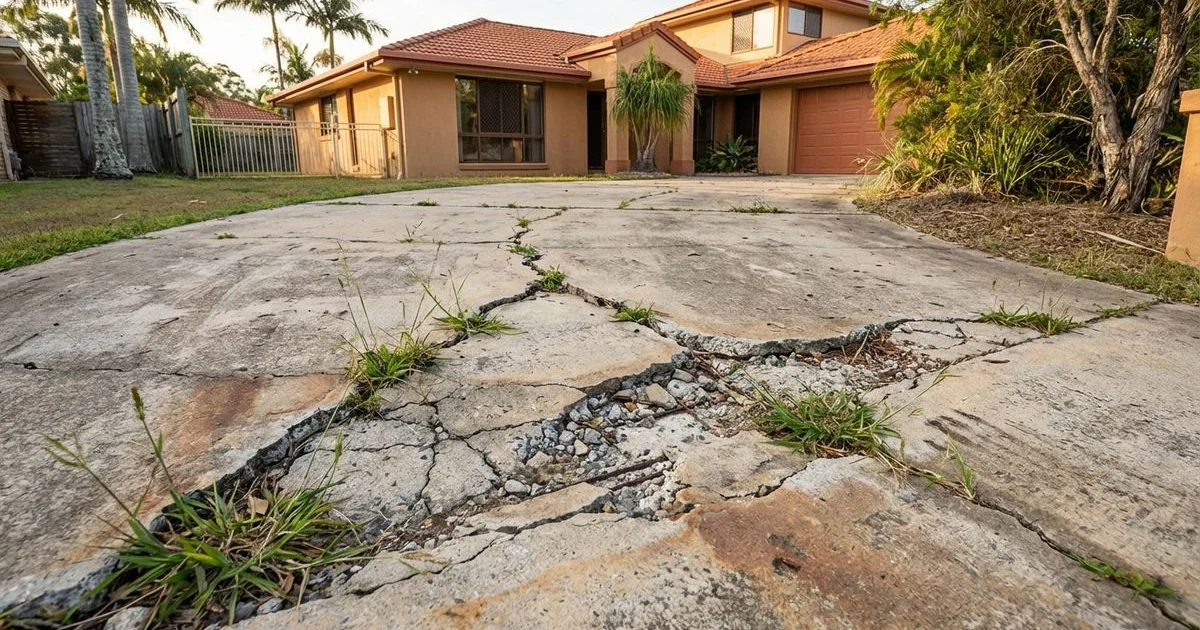
We advise inspecting your driveway for cracks twice a year.
The best times are typically October (pre-summer) and April (post-summer).
Small hairline cracks are often just shrinkage from when the concrete cured and are purely cosmetic.
However, any crack wider than 2mm to 3mm needs attention to prevent water from undermining the slab.
Reactive clay soils, common in hinterland suburbs like Robina and Varsity Lakes, swell and shrink, causing movement that widens these cracks.
For small cracks, a flexible polyurethane sealant (like Sikaflex) is superior to rigid mortar.
It moves with the concrete rather than snapping out again.
If a crack has uneven edges where one side is lower than the other, that indicates structural settling.
This usually requires a professional assessment.
Protecting Expansion Joints
Expansion joints are the straight lines cut into your driveway to control cracking.
They allow the heavy slabs to expand in the heat without shattering.
We often see the original foam or “Abel flex” material rotting away after a few years.
This leaves an open gap for weeds and ants to nest in.
Keep these joints clean.
If the filler is gone, seal the gap with a flexible joint sealant to lock out water and pests.
Seasonal Tips for Gold Coast Driveways
Summer (December-February)
- Clean up after storms promptly. Wet leaves left in the sun will stain within 24 hours.
- Keep sprinklers directed away from the driveway to prevent hard water deposits.
- Avoid applying sealer in high heat. If the surface is too hot, the sealer dries instantly and bubbles (solvent entrapment).
Winter (June-August)
- This is the best time for resealing. Lower humidity helps the sealer cure evenly without “blushing” (turning white).
- Pressure wash now to remove mould without it growing back immediately.
- Check for drainage issues. Ensure water isn’t pooling next to the driveway edge.
When to Call a Professional
While routine maintenance is manageable, some jobs carry high risks if done incorrectly.
We suggest calling in a professional for:
- Resealing exposed aggregate: Getting the coating thickness wrong can ruin the look permanently.
- Acid washing: This requires strict runoff control to comply with Gold Coast council environmental regulations.
- Structural concrete repairs: If slabs are sinking or rocking.
- Epoxy flooring: These require precise surface preparation with diamond grinders.
A qualified local concreter can tell you if your driveway just needs a facelift or if it requires more serious structural intervention.
Maintaining your driveway protects the curb appeal and value of your entire property.