Grind and Seal vs Mechanically Polished Concrete: What's the Difference?
Understand the key differences between grind and seal and mechanically polished concrete floors, including process, cost, durability, and appearance.
GC Concreting Team
Grind and Seal vs Mechanically Polished Concrete: What You Need to Know for Gold Coast Floors
If you have decided on polished concrete for your Gold Coast home or business, you will quickly encounter two main approaches: grind and seal, and mechanically polished concrete (MPC). While they might look similar in photos, the processes, results, and long-term performance are quite different.
We find that many clients initially confuse the two because they both offer that sleek, industrial look. The difference is actually quite simple: one wears a protective “raincoat,” while the other has “toughened skin.” Understanding this distinction helps you choose the option that best matches your expectations, budget, and how the floor will be used.
How Grind and Seal Works
Grind and seal is the simpler of the two processes, functioning much like applying a clear coat of varnish over timber.
- Grinding: The concrete surface is ground using diamond tooling through concrete grinding to create a smooth, even surface. The grinding is relatively shallow—just enough to remove imperfections and create a consistent base.
- Sealing: A topical sealer (usually acrylic, polyurethane, or epoxy) is applied over the ground surface. This sealer sits on top of the concrete, forming a protective film that provides the sheen and colour enhancement.
Our team typically completes this entire process in 1 to 2 days for a standard room, making it the faster option for tight renovation schedules.
The Result
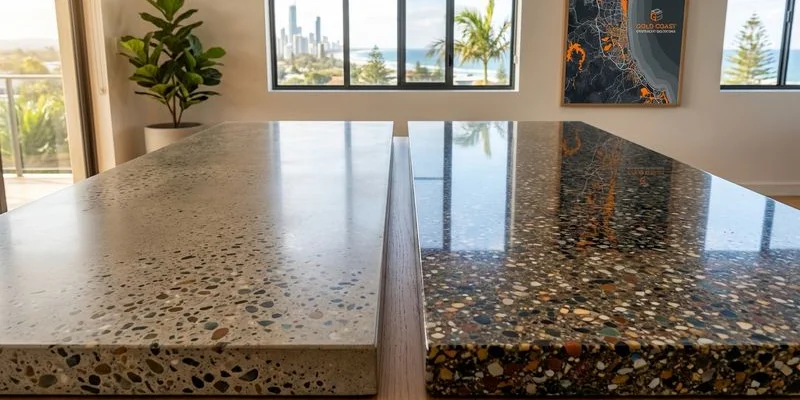
Grind and seal produces a satin to semi-gloss finish, depending on the sealer chosen. The sheen comes from the sealer coating rather than from the concrete itself. The floor looks smooth and refined, with moderate aggregate exposure depending on grinding depth.
Critical “Insider” Tip: The Humidity Factor
We always warn our Gold Coast clients about “blushing.” This occurs when high humidity—common in our region—gets trapped under a topical sealer during application, causing it to turn milky white or bubble. To avoid this, we recommend using high-quality UV-stable polyurethane sealers that are breathable and resistant to our intense Queensland sun.
How Mechanical Polishing Works
Mechanical polishing is a more involved, multi-step process that engineers the concrete slab itself into a finished floor.
- Coarse grinding: Diamond tooling progressively grinds the concrete surface, starting with coarse grits (30 to 50 grit) and working through increasingly finer grits.
- Densification: A liquid chemical densifier (typically Lithium Silicate) is applied to the concrete. This penetrates the surface and reacts with the calcium hydroxide in the cement to create calcium silicate hydrate—a harder, denser surface.
- Fine polishing: After densification, the floor is polished through additional fine grits (200, 400, 800, and potentially 1500 or 3000 grit) until the desired sheen level is achieved.
This process typically takes 3 to 5 days or longer for a standard room, depending on the finish level.
The Result
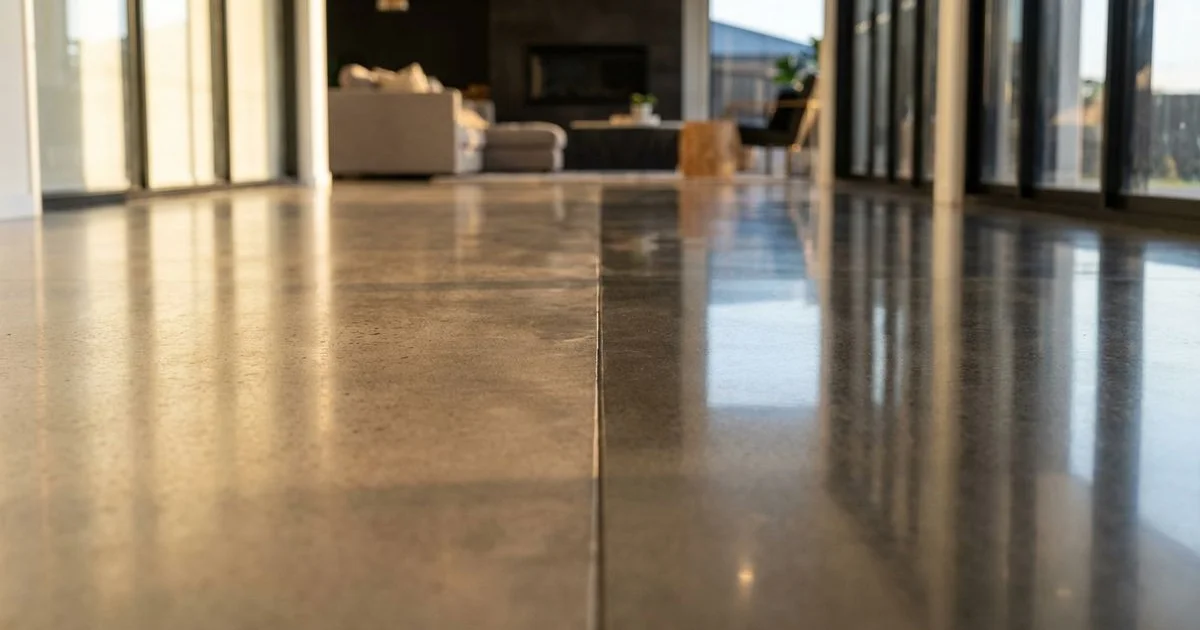
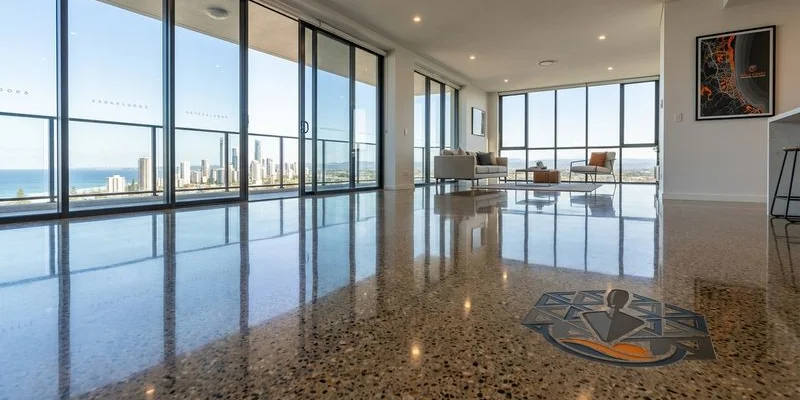
Mechanically polished concrete has a deep, rich gloss that comes from the concrete itself—not from a coating on top. The surface is actually hardened and densified, creating a floor that is stronger and more durable than the original concrete.
In fact, the densification process can increase the surface hardness from a standard 3-4 on the Mohs Hardness Scale up to a 6-7, making it comparable to steel.
Key Differences Compared
Appearance and Features
| Aspect | Grind and Seal | Mechanically Polished (MPC) |
|---|---|---|
| Sheen Source | Topical Sealer (The “Raincoat”) | The Concrete Itself (The “Skin”) |
| Gloss Level | Satin to Semi-Gloss | Low Sheen to Mirror-Like |
| Scratch Resistance | Low (Sealer scratches easily) | High (Hardened surface) |
| UV Stability | Varies (Epoxies may yellow) | Excellent (Will not yellow) |
| Slip Rating Potential | R9 - R11 (Additive dependent) | P3 / R9 (Standard) |
The most noticeable visual difference is the depth of the finish. Mechanically polished concrete has an almost three-dimensional quality to its gloss, while grind and seal looks more like a coated surface.
Durability
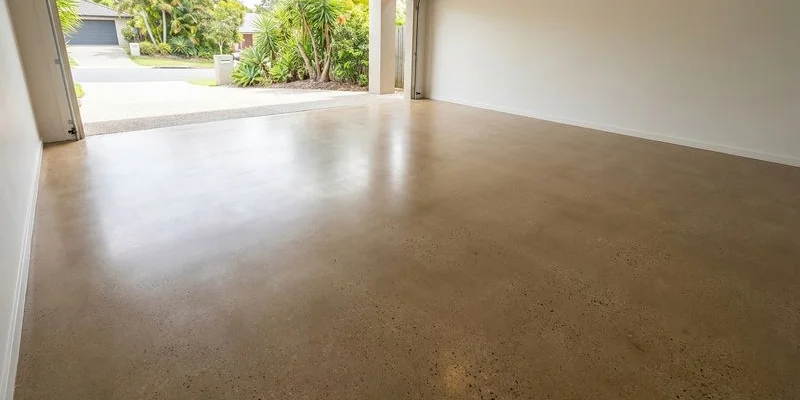
Grind and seal relies on the topical sealer for its protection and appearance. The sealer wears over time, particularly in high-traffic areas, and eventually needs to be stripped and reapplied. In a residential setting, expect the sealer to last 3 to 5 years before needing attention.
We see topical sealers fail fastest in areas with rolling chairs (like home offices) or where dog claws constantly scratch the surface.
Mechanically polished concrete is inherently harder and more wear-resistant because the densification process strengthens the concrete itself. The polish will not wear off in the same way a coating does. High-traffic areas may dull slightly over time, but a quick re-burnish (a single pass with fine diamond tooling) restores the gloss.
In Gold Coast commercial settings with heavy foot traffic—retail, cafes, offices—mechanically polished concrete significantly outperforms grind and seal in long-term durability.
Maintenance
Grind and seal maintenance:
- Daily dust mopping
- Weekly damp mopping with pH-neutral cleaner
- Periodic recoating (every 3-5 years)
- Full strip and reseal when coating deteriorates
- Avoid dragging furniture (scratches the sealer)
Mechanically polished maintenance:
- Daily dust mopping
- Weekly damp mopping with pH-neutral cleaner
- Occasional re-burnishing (every 5-10 years)
- No stripping or recoating required
- More resistant to scratching and scuffing
The ongoing maintenance cost of mechanically polished concrete is significantly lower because there is no coating to maintain. Over a 20-year period, this can represent substantial savings.
Cost
| Polish Type | Cost per m² (2026 Est.) | 80m² Room Total |
|---|---|---|
| Grind and Seal | $60 - $90 | $4,800 - $7,200 |
| Mechanically Polished | $110 - $160 | $8,800 - $12,800 |
Grind and seal costs roughly half as much upfront. However, when you factor in the ongoing resealing costs every few years, the lifetime cost gap narrows considerably.
Our estimates above reflect current Gold Coast market rates, though prices vary based on slab condition (e.g., concrete repairs) and access (e.g., apartments with lifts vs. ground floor).
Slip Resistance
Both options can be configured for appropriate slip resistance to meet Australian Standard AS 4586. Mechanically polished floors at very high gloss levels can become slippery when wet, so they are generally not recommended for wet areas or outdoor applications without specific non-slip treatments.
We typically target a P3 (Pendulum) or R9 (Ramp) rating for indoor living areas, which offers a safe balance between grip and cleanability.
Grind and seal floors can incorporate non-slip additives in the sealer, providing better grip in areas where moisture is a concern. This makes grind and seal a practical choice for Gold Coast covered patios and pool surround-adjacent indoor areas where you might need an R10 or R11 rating.
Moisture Sensitivity
Grind and seal can be sensitive to moisture. If moisture rises through the slab (a common issue in Gold Coast areas with high water tables, like canal estates), it can cause the topical sealer to bubble, peel, or turn white. A moisture test before installation is essential.
Mechanically polished concrete handles moisture better because there is no topical coating to be affected. The densifier creates a harder surface that is less permeable, and there is no film on top that moisture can disrupt.
Which Is Right for Your Gold Coast Project?
Choose Grind and Seal If:
- Your budget is more conservative ($60-$90/m²)
- You want a quick turnaround (1-2 days)
- The area has moderate foot traffic (bedrooms, living rooms)
- You are happy to maintain and reseal periodically
- You want a satin rather than high-gloss finish
Choose Mechanically Polished If:
- You want the highest quality, longest-lasting finish
- The area will experience heavy foot traffic (commercial, open-plan living)
- You prefer minimal ongoing maintenance
- You want a deep, lustrous gloss that comes from the concrete itself
- Long-term value is more important than upfront savings
A Note on Existing vs New Slabs
Both processes work on existing and new slabs, but the results can vary. New slabs poured with polishing in mind (using harder aggregates and a suitable mix design) produce consistently superior results with either method.
We often find that older existing slabs in Gold Coast homes can still produce beautiful floors, but they may have “character” marks like trench lines or variable aggregate. A test grind is always recommended to assess the concrete quality and aggregate character before committing to the full project.