Coloured Concrete vs Exposed Aggregate: Which Driveway Finish Is Right for You?
Compare coloured concrete and exposed aggregate driveways side by side. Learn the pros, cons, costs, and best applications for Gold Coast homes.
Daniel Mercer
Choosing Between Coloured Concrete and Exposed Aggregate
You know that specific feeling when you pull up to a home and the driveway just looks right?
We see homeowners on the Gold Coast wrestle with this decision every week.
The choice between coloured concrete and exposed aggregate often determines the entire street appeal of a property.
Our team has poured thousands of square metres of both concrete driveways, so we understand exactly how they hold up against the Queensland sun and summer storms.
This guide breaks down the real costs, the maintenance facts, and the safety ratings needed to help you make the right call.
What Is Coloured Concrete?
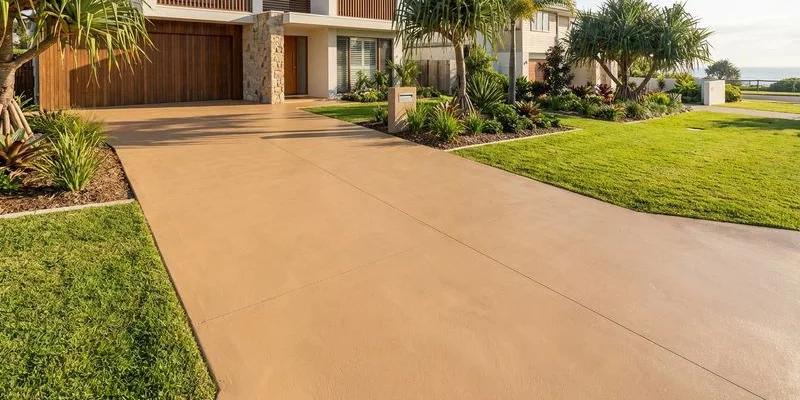
Coloured concrete involves mixing a specific oxide pigment directly into the truck before the concrete is poured.
We ensure the colour runs through the entire depth of the slab rather than just sitting on top.
This integral method means deep scratches or chips won’t reveal grey concrete underneath.
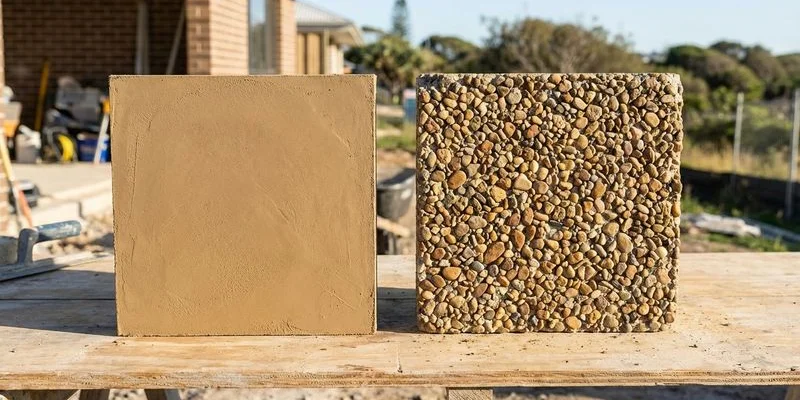
The finish is typically smooth, clean, and uniform.
Our clients often choose this style for:
- Sandstone tones: These warm colours blend perfectly with coastal brickwork.
- Charcoal and Black: Darker shades hide oil stains well and suit modern render.
- Terracotta: A classic choice that adds warmth to neutral home exteriors.
- Grey and Pewter: Subtle options that provide a clean look without drawing too much attention.
What Is Exposed Aggregate?
Exposed aggregate reveals the natural beauty of the stone within the concrete mix.
We pour a wet concrete mix loaded with decorative stones and then spray a chemical retarder on the surface.
The top layer of cement paste is washed away after a few hours to uncover the durable rock beneath.
This process results in a textured, high-grip surface that feels solid underfoot and looks organic.
Common mixes we use locally include:
- Salt and Pepper: A classic black and white mix that hides dirt exceptionally well.
- Gold Coast Blends: Combinations of river pebbles and crushed quartz that sparkle in the sunlight.
- Red and Brown Earth: Warmer stones that suit hinterland properties or brick homes.
- Custom Mixes: You can select specific stones to match garden features or retaining walls.
Head-to-Head Comparison
Cost Analysis
Price is often the deciding factor for renovations and new builds alike.
We find that exposed aggregate consistently costs more due to the extra labor involved in the wash-off process and the higher cost of decorative stone mixes.
Standard concrete prices have shifted in 2025 due to material costs, so here is a realistic breakdown for the Gold Coast region.
| Feature | Coloured Concrete | Exposed Aggregate |
|---|---|---|
| Price Per Square Metre | $95 - $130 | $130 - $180 |
| Material Cost | Lower (Standard mix + Oxide) | Higher (Decorative stone mix) |
| Labor Intensity | Moderate (Pour + Finish) | High (Pour + Retard + Wash) |
| Avg. Driveway (60m²) | $5,700 - $7,800 | $7,800 - $10,800 |
Note: Prices are estimates and vary based on excavation requirements, site access, and steel reinforcement needs.
Appearance and Aesthetics
Coloured concrete offers a sleek and minimalist finish.
We recommend this for modern architectural styles where clean lines are a priority.
The colour is consistent across the entire surface, which creates a very deliberate and engineered look.
Exposed aggregate provides a natural and textured aesthetic.
Our customers who want a rugged or organic feel usually prefer this option.
The variation in the stones means that dirt and leaves are less visible, which keeps the driveway looking cleaner for longer.
Durability and Lifespan
Both options are incredibly strong when installed correctly with steel mesh reinforcement.
We construct both types to withstand the weight of passenger vehicles and the harsh UV exposure of Queensland summers.
Exposed aggregate holds a slight advantage in surface hardness.
The top layer is solid stone rather than cement paste, making it more resistant to surface abrasion and tyre marks.
Coloured concrete is still durable but can show tyre friction marks more easily if you turn your wheels while the car is stationary.
Slip Resistance and Safety
Safety is a non-negotiable factor for sloping blocks.
We strictly follow Australian Standards (AS 4586) regarding slip resistance ratings.
Exposed aggregate naturally provides a high grip rating, often reaching R11 or R12 classifications.
This texture makes it the superior choice for steep driveways in hilly suburbs like Mudgeeraba, Tallai, or Highland Park.
Coloured concrete is smoother by nature.
Our team can add a “cove” or “broom” finish to coloured concrete to increase traction, or mix a non-slip additive into the sealer.
However, standard smooth coloured concrete can become slippery when wet if these steps are not taken.
Maintenance Requirements
Every concrete surface requires some level of care to look its best.
We advise all clients that resealing is necessary every 2 to 3 years depending on weather exposure.
Coloured Concrete Maintenance:
- Easier to clean with a standard hose or broom.
- Shows oil leaks and tyre marks more clearly.
- Resealing restores the colour vibrancy instantly.
Exposed Aggregate Maintenance:
- Hides stains and dust effectively.
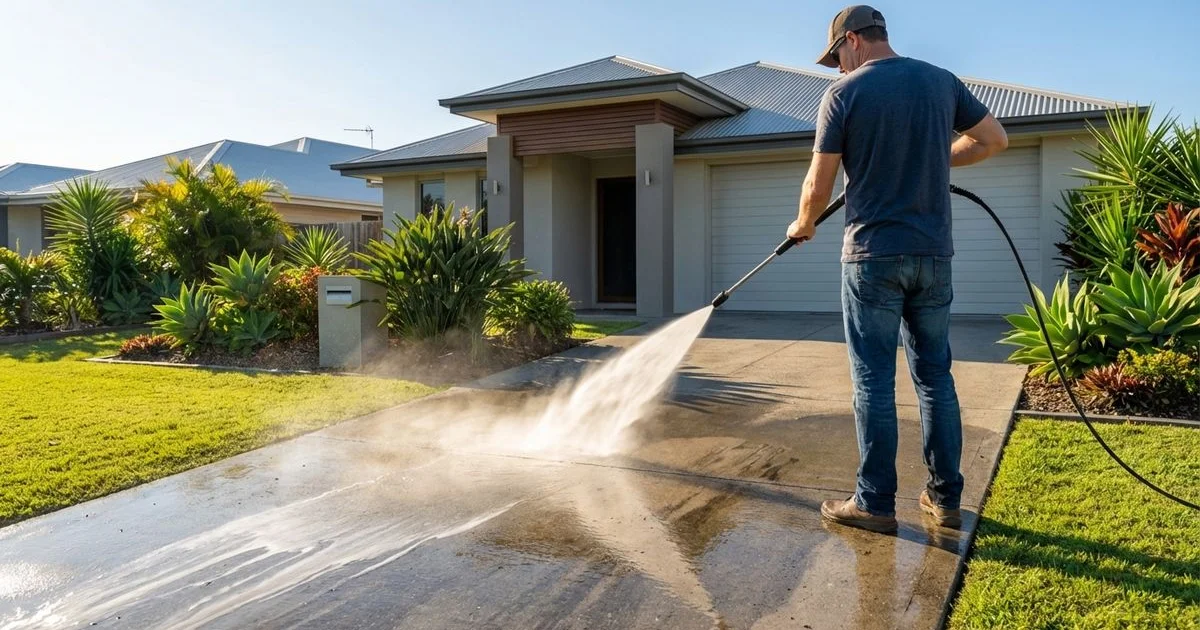
- Requires a high-pressure washer to remove dirt trapped between the stones.
- Algae and moss can grow in the texture if the driveway is in constant shade.
Colour Longevity
Fading is a common concern for homeowners.
We use high-quality oxides from reputable suppliers like Concrete Colour Systems (CCS) to minimise fading in coloured concrete.
The colour is integral, but UV radiation will slowly lighten the surface over 10 to 15 years.
Exposed aggregate relies on the natural colour of the rock.
The stones themselves do not fade, which means the base colour remains permanent.
A quality sealer brings out the “wet look” of the stones, and simply resealing the driveway will bring it back to new condition even after a decade.
Which Finish Suits Your Home?
Choose Coloured Concrete If:
- You want a modern and minimalist look.
- The budget is a primary constraint.
- Your driveway is flat or has a gentle slope.
- You prefer a surface that is easy to sweep and keep dust-free.
Choose Exposed Aggregate If:
- You prefer a premium and natural stone appearance.
- The driveway is steep and requires maximum grip.
- You want a surface that hides light dirt and footprints.
- You are willing to invest more upfront for better long-term wear.
Can You Combine Both Finishes?
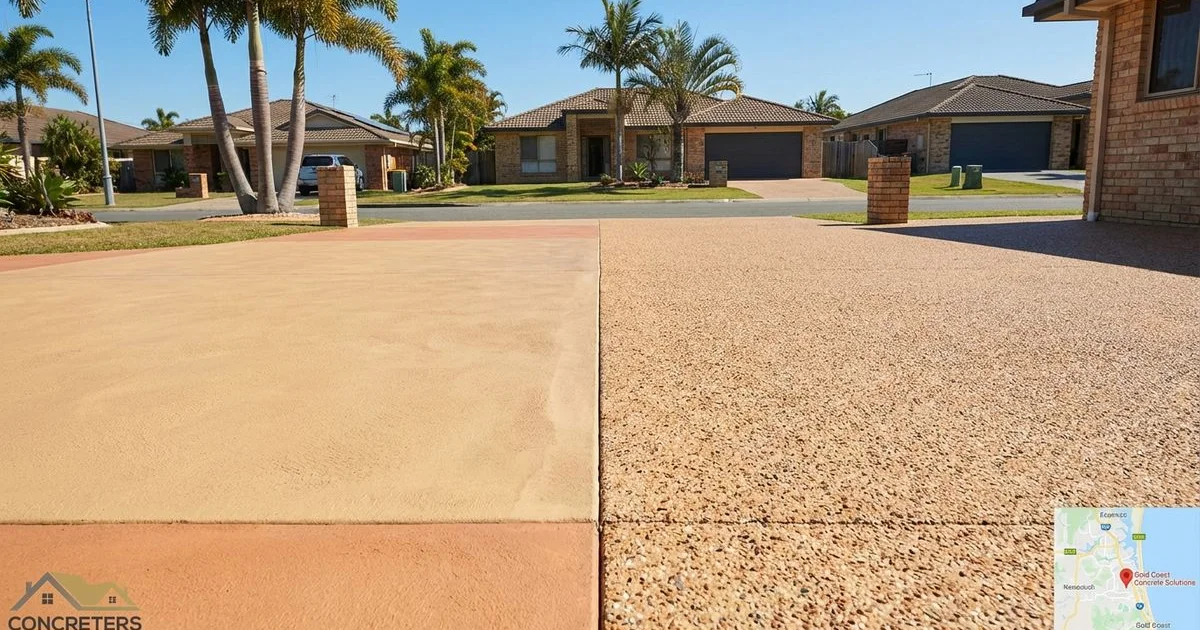
Yes, mixing these two finishes is a fantastic way to add character to your property.
We often pour a main driveway in exposed aggregate and frame it with a smooth coloured concrete border.
This technique is known as “banding.”
The contrast between the rugged stone centre and the smooth, solid border looks sharp and professional.
It also reduces costs slightly compared to doing the entire area in exposed aggregate.
Your design choices are limitless when you start combining textures and colours.
Summary Checklist
Making the final decision can be tough.
We have created this quick checklist to help you verify your choice before booking a quote.
- Check the Gradient: Is your driveway steep? If yes, lean towards exposed aggregate for the safety rating.
- Check the Budget: does the extra $30-$50 per square metre fit your financial plan?
- Check the Style: Look at your roof tiles and bricks. Do you need a solid block of colour to match, or would natural stone texture soften the look?
- Check the Maintenance: Are you prepared to pressure wash the textured surface of exposed aggregate, or do you want the easy sweep of smooth concrete?
Our team is ready to walk you through samples and recent projects to help you visualise the final result.
Getting this right adds value to your home and saves you money on maintenance in the long run.